
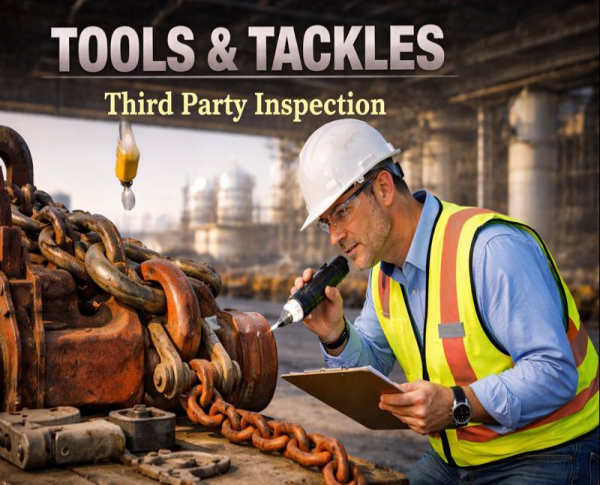
Tools and Tackles Third Party Inspection
Tools & Tackles Third Party Inspection (TPI): Ensuring Safety, Compliance & Reliability
In industries such as construction, manufacturing, power plants, oil & gas, HVAC installation, and maintenance works, tools and tackles play a critical role in daily operations. Lifting tools, rigging equipment, hand tools, and mechanical tackles are constantly exposed to load, wear, and harsh working conditions.
To prevent accidents, injuries, and equipment failure, Tools & Tackles Third Party Inspection (TPI) is essential. A professional TPI ensures that all tools and tackles are safe, compliant, and fit for use before and during operations.
Why Tools & Tackles Third Party Inspection Is Important?
Tools & Tackles TPI is not just a legal requirement—it is a lifesaving process.
Key reasons why TPI is crucial:
- Prevents accidents caused by tool failure
- Ensures compliance with statutory and client safety requirements
- Identifies defects, wear, corrosion, or misuse at an early stage
- Improves equipment reliability and service life
- Reduces downtime and costly breakdowns
- Builds confidence among workers and management
A single failed shackle, sling, or lifting tool can result in serious injury or fatal accidents. Third Party Inspection ensures independent and unbiased verification of safety.
When Should Tools & Tackles Third Party Inspection Be Performed?
TPI for tools and tackles should be carried out at the following stages:
- Before first use (new or newly procured tools)
- Before commissioning at site
- Periodically, as per statutory or company requirements
- After repairs, modification, or alteration
- After any accident or overload
- Before critical lifting or high-risk operations
Who Will Perform Tools & Tackles Third Party Inspection?
Tools & Tackles TPI must be carried out by a competent and authorized third-party inspector.
Who Is a Competent Person?
Competent Person must be recognized and approved by the Department of Factories, Boilers, Industrial Safety & Health of State Government
Competent person is an individual who has the necessary knowledge, training, experience, and authority to inspect tools and tackles and identify existing or potential hazards.
- Have relevant technical qualifications
- Possess experience in tools & tackles inspection
- Be knowledgeable in applicable standards and regulations
- Be independent from daily operations
- Be authorized to issue inspection reports and certificates
Third party inspection provides neutral, expert evaluation, which internal checks may not always ensure.
Tools & Tackles Covered Under Third Party Inspection
Typical tools and tackles inspected include:
- Wire rope slings
- Chain slings
- Webbing slings
- Shackles (bow, D, anchor type)
- Hooks and swivels
- Turnbuckles
- Eye bolts and lifting points
- Manual chain blocks
- Lever hoists
- Lifting beams and spreader bars
- Hand tools used for critical operations
What Checks Are Done During Tools & Tackles TPI?
During the inspection, the following checks are carried out:
1. Visual Inspection
- Cracks, deformation, corrosion, wear
- Damaged threads, pins, hooks, or links
- Missing identification tags or markings
- Improper repairs or modifications
2. Dimensional Checks
- Measurement of wear limits
- Elongation of chains
- Throat opening of hooks
- Diameter reduction in wire ropes
3. Identification & Marking
- Safe Working Load (SWL)
- Manufacturer details
- Serial number or unique ID
- Color coding (if applicable)
4. Functional Checks
- Smooth operation of moving parts
- Brake and locking mechanisms
- Proper alignment and movement
How Are Tests Performed During Tools & Tackles Inspection?
Depending on the tool type and standard requirements, the following tests may be conducted:
Load Testing
- Applied load as per standard (typically 1.25 to 2 times SWL)
- Monitoring for deformation or failure
Non-Destructive Testing (If Required)
- Magnetic Particle Testing (MPT)
- Dye Penetrant Testing (DPT)
- Visual magnification inspection
Operational Testing
- Checking hoists under no-load and load conditions
- Verifying braking efficiency and safety mechanisms
All tests are conducted in a controlled and safe manner, following approved procedures.
Inspection Frequency for Tools & Tackles?
The inspection interval depends on usage, environment, and statutory guidelines:
- Lifting tools & tackles – Every 6 or 12 months
- Heavy-use or critical tools – More frequent inspection
- Before each use – Visual check by user
- After repairs or damage – Mandatory re-inspection
A proper inspection schedule significantly reduces workplace risks.
Conclusion
Tools & Tackles Third Party Inspection is a critical safety requirement for any industry involving lifting, rigging, and mechanical operations. Regular TPI ensures compliance, protects workers, and prevents costly accidents.
By engaging a professional and competent third party inspection service, organizations can confidently operate with safe, certified, and reliable tools & tackles.
Safety starts with inspection — and inspection saves lives.